
Handling a PR crisis is hard. Doing it across many markets like Western Europe and Central and Eastern Europe (CEE) is even harder. Culture, media, and politics can be very different from one country to another.
So, how do you deal with a crisis in a smart way across both? You need a clear plan that keeps your brand story consistent while allowing local teams to adapt your message. One plan for all will not work. What works in Berlin may cause problems in Budapest. You need a deep understanding of each market, guided by multicultural marketing best practices.
This article covers how to manage reputation risks in Western Europe and CEE. You will find the main differences between the two regions, key challenges to watch out for, and practical steps to control a crisis and protect your brand.
A PR crisis is any event that harms your reputation and your relationship with customers, partners, staff, investors, or the public. In a multinational setup, the same event can look very different across borders.
Something small in one country may become a headline story in another. This shows why local insight matters.
Because news and social media spread fast across borders, a local issue can turn global in hours. You need to spot early risks and act fast, with local needs in mind, before the issue grows.
Crises rarely follow the same path in each country. In Western Europe, common triggers include consumer safety, data privacy, and ethics in business. Media are often investigative and well-resourced. People expect clear answers and quick action. Regulatory bodies are active and can move fast.
In CEE, those issues matter too, but politics, history, and geopolitics can play a bigger role. Media can be mixed in quality and independence, and public trust in traditional outlets may be unstable.
In Slovakia, trust in traditional media has dropped more than in other CEE markets, and Facebook is a main news source, including false stories. The same event can cause very different reactions and will need different messages.
That’s why understanding local nuances is essential when planning communication in the region. Experienced agencies such as All4Comms help international brands navigate these differences, adapting their PR and marketing strategies to fit each market’s unique media landscape and public sentiment.
| Aspect | Western Europe | CEE |
| Typical drivers | Consumer safety, data privacy, ESG, ethics | Politics, history, national identity, ESG (growing) |
| Media | Independent, investigative, structured | Mixed independence, more online/social in some markets |
| Public reaction | High demand for transparency and proof | Can be polarized; trust levels vary by country |
| Regulators | Strong and active (e.g., GDPR) | Vary by country; politics can shape outcomes |
In Western Europe, ESG topics get a lot of attention: supply chains, labor rights, carbon impact, and data handling. Activists and regulators watch closely. Consumer groups can mobilize fast, and boycotts are possible. People expect brands to act with care and back claims with evidence.
In CEE, ESG is rising, but other triggers may stand out. History, national pride, and political ties can shape reactions. A brand seen as favoring one political side, or mishandling sensitive issues, can face backlash.
Rapid growth over the past 30 years also shapes topics like urban growth, jobs moving across borders, or infrastructure. These can spark debate and anger. You need to read the deeper social signals in each country.
Europe is not one media market. Western Europe has older democracies, mature media, and strong laws. Public debate is active and structured. CEE has many democracies at different stages of development, fast-changing media scenes, and countries still dealing with post-communist legacies. The result: different rules, habits, and risks.
Knowing these basics is the first step to a good multi-country PR plan. Ignoring them can cause costly mistakes and harm your reputation.
In Western Europe, media systems are well-developed. Independent journalism and press freedom are strong. Editorial content is separate from ads. Journalists expect clear, open, and evidence-based answers. In the UK, messages should stress responsibility with data. In Germany, focus on compliance and measurable results.
CEE media varies. Poland and Czechia have many features similar to Western Europe. Other markets have fewer print outlets and lean more on digital, blogs, and social channels. Journalist styles differ too. Polish reporters may be very direct and ask many questions in press briefings. Czech reporters may stay quiet during the briefing and follow up later. In some places, a few large owners control many outlets, which can make unpaid coverage harder. In Hungary, paid content can take a larger role.
Politics and culture shape PR in both regions. In Western Europe, political stability and strong courts give a stable legal base. People value individual rights, the environment, and social justice. Data privacy rules like GDPR set high standards for openness and data care.
In CEE, laws and politics can shift more often. Most countries are in NATO and the EU, which brings stability and access, but political sensitivities can still run high. Hungary is the most right-leaning in CEE, and politics strongly shape media there. Culture and language differ deeply across CEE.
As Michał Rakowski notes, Romanian is closer to French than to Slavic languages, and outside of Czechia and Slovakia, people across CEE usually do not understand each other’s languages. Religion also varies (Catholic Visegrád vs. Orthodox Balkans and Ukraine). Plans must be carefully adapted for each country. Ukraine, in war, needs extra care in all messages.
Trust and perception drive PR outcomes. In Western Europe, people expect clear, ethical behavior. Trust in institutions varies but often gives a base you can work with. Consumers are well-informed and quick to react if they feel misled, especially on consumer rights or the environment.
In CEE, trust can be more mixed. History with state control and propaganda can fuel doubt toward official messages. Trust in public media is steady in some places (e.g., Czechia) and falling in others (e.g., Slovakia).
Many people have strong national pride and support local firms. In Poland, people may be very sensitive about fair treatment and respect, shaped by history. A message that calms people in Western Europe might sound patronizing in parts of CEE. Local tone matters.
Managing a PR crisis across many countries is like solving a puzzle with many moving parts. Culture, language, media, and law all differ. You need one brand message, but it must feel right in each place, especially across Western Europe and CEE.
A big risk is pushing one blanket plan across all markets. That often backfires, confuses people, and can make the crisis worse. Keep the brand steady, but keep it relevant to each country.
A common mistake is treating CEE as one market. It is not. Yes, digital adoption is high and many CEE countries are in the EU, but the differences inside the region are deep. As Michał Rakowski says, “societies in the given countries do not have that much in common!”
Estonia is closer to Scandinavia than to Bulgaria. Serbia and Czechia are at different stages of economic growth. Languages and religions vary. National identities are strong. One crisis plan for Poland, Hungary, Czechia, the Baltics, and the Balkans will miss the mark. You will lose local trust and fail to address real concerns. What works in secular Czechia (with high rates of atheism) may not work in a more religious society.
Language is a big challenge and often underestimated. Each CEE country has its own language. English works with some younger groups, like in Slovakia, but in a crisis you should speak the local language.
Patrik Schober of PRAM Consulting advises against first-contact emails in English to CEE journalists; they may not even open them. Use local translators at the start and build relationships.
Go beyond simple translation. Use transcreation so tone, references, and emotion fit the audience. This matters in a crisis, where one wrong word can cause new trouble.
In Ukraine, due to the war, messages need extra care, and the Cyrillic script brings added hurdles for non-Ukrainians. Create local crisis playbooks for each country.
Keeping one message while adapting to local needs is tricky. Different teams may change the core story in different ways. That can confuse people and damage trust, especially online where gaps show fast.
A global program should think “local first” to work well, as Connor Murphy of Remote notes. Keep one story and values across markets, but change the examples, proof points, and tone for each country. Jenna Hudson of Yext stresses the need to adapt for each market. This needs strong central direction and strong local teams who know how far to adapt without changing the core.
Western Europe and CEE share a continent but have different legal and reputational risks. If you work in both, you deal with many rules, politics, and public expectations. One simple plan for all places can break legal rules and harm your name.
Knowing these risks helps any multinational protect its standing and trust. Mistakes can lead to fines, lawsuits, or wide public backlash.
Politics can shape a crisis in many CEE countries. History and the legacy of communism influence public debate. A business issue can quickly become political if it touches on national pride, history, or geopolitics.
Your actions may be seen as taking sides or dismissing local identity. That can cause a strong reaction. Poland is highly divided, similar to the US, with “East” vs. “West” views on the EU, courts, or LGBTQ+ rights. In Hungary, the state has strong media influence, and crises can be politicized. Work with care, show respect, and avoid taking sides.
Western Europe has strict rules, especially on privacy, openness, and business conduct. GDPR sets tough standards for data use. A data breach brings heavy fines and big reputational damage, alongside demands for quick, honest communication.
People expect openness across topics like environment and labor. Regulators are active, and the public can turn on brands seen as hiding facts. Work closely with legal teams. Show clear actions, compliance, and real fixes, with measurable results, as expected in Germany and the UK.
Building a solid crisis plan for Western Europe and CEE is not just about having a document on a shelf. You need a flexible setup that can adjust under pressure. Match global goals with local realities. Give local teams power, and keep central guidance tight.
Your aim: act fast, speak clearly, and protect trust across all markets.
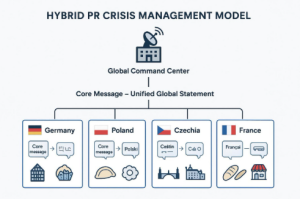
A hybrid model works best. A central team sets policies, core messages, and strategy. This helps keep the brand steady across markets and provides one point of contact for global stakeholders.
Local execution is key. Local teams know the press, culture, and politics. They read local mood, work with journalists, and adjust tactics. Tyto’s PRWithoutBorders™ model shows how one coordinated team across countries can move fast and scale. Let local agencies or managers lead on the ground, while the center supports and keeps alignment.
Keep one clear global message: what happened, what you are doing, and what you learned. Build this at the center so facts are correct and aligned with strategy.
Then adapt the delivery for each market. Pick the right spokesperson, choose local examples, and use language and tone that fit. In France, stress community impact. In the Netherlands, stress innovation. In CEE, adapt even more because of language and history differences. Let each country’s story reflect its culture so people accept it and trust it.
Local teams are key to success. They know the media, influencers, and public mood. They can tell local stories that resonate, as Connor Murphy of Remote notes. In Western Europe, press may ask for detailed proof. In some CEE markets, local community impact may matter more.
During a crisis, local teams act first. They turn central guidance into local actions, speak the language, and give feedback to the center. They know which channels and voices work. With clear roles and support, they stop small fires from spreading across borders.
Choosing between international partners and local agencies (or both) is a big call. International partners with a strong European network bring one strategy across many countries and keep messaging steady. They can run complex campaigns and act as the main coordinator, like Enterie does for CEE-wide work.
Local agencies bring deep market knowledge, strong press ties, and practical know-how on local “DOs and DON’Ts.” PRAM Consulting in Czechia, for example, runs Eurowag’s work across several CEE countries using partner agencies in The Worldcom PR Group. This hub-and-spoke model keeps central direction while local teams execute.
In Poland, where PR is very advanced, local firms can run modern, digital-first programs and even lead region-wide work. A mixed model often gives the best results: central strategy plus local expertise.
Good crisis communication is about the right message, the right person, and the right channel. Western Europe and CEE need different mixes. A tool that works well in one place may fail in another. Build trust and reduce harm by fitting your plan to local habits and expectations.
Use local voices, prepare spokespeople for local press styles, and pick channels and languages people actually use.
Local influencers and experts can add trust in both regions. They can validate your message, add context, and help explain technical issues. In Western Europe, consider academics, consumer advocates, or respected industry leaders.
In CEE, where trust in institutions can be mixed, local community voices and industry experts can be even more helpful. Choose carefully. A polarizing figure can make things worse. Match the voice to the local audience and topic.
Train spokespeople for local press styles. In Western Europe, expect detailed, data-heavy questions. In the UK, stress responsibility and data. In Germany, stress compliance and measurable outcomes. Keep the tone formal and open.
In Poland, be ready for many direct questions and fast follow-ups. In Czechia, give a full statement first and prepare for later questions. In Hungary, face-to-face time with journalists is rare, and paid content has grown, so adjust your approach. Media training should reflect local formats, tone, and pressure levels so spokespeople stay clear and confident.
Pick channels and languages people trust in each market. In Western Europe, use a mix: print, TV, digital outlets, and your own social channels. Publish in key national languages and English.
In CEE, go more granular. In Poland and Czechia, traditional media still matter, but online outlets, blogs, and podcasts are strong. In Slovakia, Facebook is a main news source, but it can spread false stories, so manage it with care. Use the local language in every country. An English-only plan will fall flat. In Ukraine, the Cyrillic script adds another layer. Local agencies can help you reach the right channels and avoid misunderstandings.
After a crisis, you have a chance to improve. Build solid systems to track and study what happened in each market. Do more than count clips. Look at public mood, regulator reactions, and how your teams changed operations.
By watching how a crisis moves through Western Europe and CEE, you can learn fast, prepare better, and come out stronger next time.
Track media tone and public mood carefully across all affected countries. In Western Europe, monitor major outlets, trade media, and social platforms. Use sentiment tools to spot shifts and new worries. People expect clear answers; fix negative trends with direct, honest updates.
In CEE, watch diverse media sources, plus blogs, forums, and local social channels. In Slovakia, Facebook is central. Monitor in local languages and factor in cultural context. Find who shapes the conversation and see if your messages land as planned. Regular monthly or quarterly reports, as Gabrielle Moreau from Contentsquare suggests, help you adjust fast.
Study past crises-yours and others’. In Western Europe, many crises involve privacy, the environment, or corporate ethics. A major car maker’s emissions case showed the high cost of failing on rules and public trust. The lesson: proactive compliance, strong controls, and an honest culture.
In CEE, learn to avoid treating the region as one market. E-commerce players like eBay and Shopee misread Poland and lost to local leader Allegro. Amazon, by opening a local hub and localizing, showed a better path. Also, be alert to politics; any sign of taking sides can make a crisis worse. These lessons show how local context shapes outcomes and why deep localization matters.
Use what you learn to update your plans. If one topic triggers stronger pushback in a certain country (e.g., environment in Germany, politics in Hungary), prepare deeper responses and allocate more resources there.
Update local playbooks, refresh media training for local press styles, and set clear steps for using local experts and influencers. Wins from one market can help in others. If a digital-first plan worked well in one CEE country, adapt parts of it for other digital-heavy markets. Keep reviewing results and refining your approach to build a smarter, more resilient system.
To face a multi-market crisis, you need a strong plan and real local insight. A single playbook will not do. The winning approach mixes one clear global story with flexible local delivery. The aim is to protect your name and show respect for each country you serve.
Here are the key moves:
Do this well and a tough multi-market crisis can become proof of your brand’s resilience and responsible global behavior.